If you are looking for a rental investment in Springfield, the area near the Medical District deserves a close look. This part of the city is tied to major hospitals, medical education, and workforce activity, which can support steady rental demand. If you want a practical way to screen deals without guessing, this guide will help you understand the renter base, likely property types, and how to evaluate numbers before you buy. Let’s dive in.
Why the Medical District matters
Springfield’s Mid-Illinois Medical District is a state-defined district bordered by 11th Street, North Grand Avenue, Walnut Street, and Madison Street. The district was created with a clear connection to medical services, education, and related development. State law also specifically authorizes housing for interns, nurses, students, and employees, which shows that residential use is part of the area’s long-term purpose.
That matters if you are an investor. Instead of relying on one type of renter, you are looking at an area supported by hospitals, a medical school, training programs, and nearby higher education. That can create a broader and more stable renter pool than a market that depends on just one employer or one campus.
Who rents near the district
Several major institutions help drive housing demand in and around this part of Springfield. SIU School of Medicine’s main campus is on North Rutledge Street, Springfield Memorial Hospital is on North First Street, HSHS St. John’s Hospital is on East Carpenter Street, and LLCC-Medical District operates on West Mason Street. The University of Illinois Springfield also adds to the area’s education and relocation pipeline.
SIU School of Medicine reports 320 current medical students, 423 residents and fellows, 26 Springfield buildings, and 1,087 civil service employees in Springfield and its clinical satellites. UIS reports 4,364 students in fall 2025, with campus housing 83% occupied based on available beds. Memorial and LLCC also strengthen the area’s role as a center for healthcare training, employment, and continuing education.
For you as an investor, this points to a renter pool that may include:
- Medical students
- Residents and fellows
- Hospital employees
- Adult learners and trainees
- Relocating professionals
- Workforce renters who want access to downtown and major employers
What the Springfield rental market shows
Springfield had an estimated population of 112,949 in 2024, with an owner-occupied housing rate of 63.4% and a median gross rent of $945. In simple terms, that means the city has a meaningful renter base. It is not a niche student market, and it is not purely owner-occupied either.
Citywide rent data gives you a useful starting point when you compare deals near the Medical District. Apartments.com reported an average Springfield rent of $923 per month in March 2026. Typical rents were about $762 for studios, $923 for one-bedroom units, $1,138 for two-bedroom units, and $1,411 for three-bedroom units.
Another useful detail is that 45% of Springfield rents fall between $700 and $1,000. That range helps frame what many renters may be able to pay in the local market. If a property near the Medical District needs rents far above that range to make the numbers work, you may want to underwrite very carefully.
Rent ranges near the district
Nearby ZIP codes show a mix of price points and inventory. Current Apartments.com inventory lists 61 apartments in 62702, 132 in 62703, and 136 in 62704. That gives you an active sample of asking rents and available product around the district and downtown area.
Examples from those ZIP codes show a practical spread rather than a luxury-heavy market. In 62704, listings include studios around $730, one-bedroom units around $875, and two-bedroom units around $925. In 62703, examples range from about $600 for one-bedroom units to $1,152 or more for two-bedroom units.
In 62702, one-bedroom units appear around $925 to $1,100 or more, while two-bedroom houses or condos show up roughly between $900 and $1,350 or more. Some three-bedroom houses are listed around $1,200 to $1,550. These are not guarantees of rent, but they are useful live comps when you are testing an investment property’s income potential.
Use FMR as a ceiling check
HUD’s FY2026 small-area Fair Market Rents can help you sanity-check your projections. These figures represent gross rent, which includes tenant-paid utilities other than telephone, cable or satellite TV, and internet. In nearby Springfield ZIP codes, reviewed one-bedroom FMRs range roughly from $930 to $1,180, while two-bedroom FMRs range roughly from $1,150 to $1,460.
Think of those numbers as one screening tool, not a pricing shortcut. Live listing comps, unit condition, layout, parking, and location still matter. Still, if your projected rent is far outside both local comps and the small-area FMR range, that is a sign to slow down and review your assumptions.
Best property types to consider
Near Springfield’s Medical District, the most practical investment plays are usually the ones that match the area’s renter base and housing mix. A Springfield housing needs assessment found that the local study area had a meaningful multifamily base, and downtown renter-occupied housing in that study area was over 90% multifamily. Even though that data is older and should be treated as structural context, it helps explain why smaller multifamily properties still make sense near the district.
Current listings also show a mix of apartments, townhomes, condos, and detached houses. That variety is helpful if you are trying to match a property type to a specific strategy. You are not limited to one product category.
The most likely options to explore include:
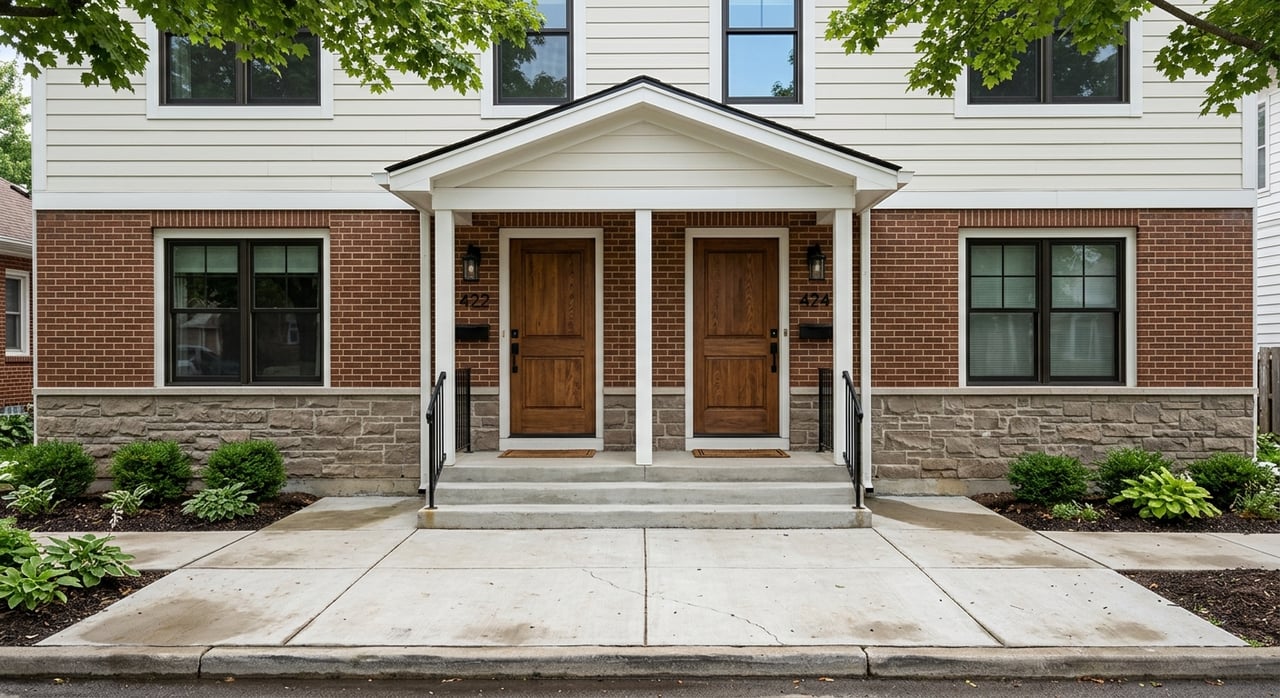
- Two- to four-unit buildings for small portfolio growth
- Detached houses that can work for house-hacking or longer-term workforce rentals
- Townhomes or condos that may appeal to relocating professionals seeking lower-maintenance living
This submarket looks more like an institution-driven rental area than a luxury landlord market. That can be a good thing if your goal is stable occupancy and realistic rent levels.
What investors should know about competition
Springfield’s acquisition market remains active. Illinois REALTORS reported 2,633 closed sales in the Springfield MSA in 2025, which was up 0.6% from 2024. The same report noted that home prices were up 11.2% from December 2024 to December 2025, while inventory was down nearly 13% over that period.
For you, that means finding a strong investment may require speed and discipline. You may need to review comps quickly, know your maximum price before touring, and stay realistic about renovation costs. In a tighter inventory market, the best opportunities may be the properties with clear value-add potential or pricing that still works against local rent levels.
How to evaluate a Springfield rental deal
A simple framework can help you avoid chasing properties that do not fit your goals. Start broad, then narrow down. This keeps your search grounded in data instead of emotion.
Start with a target ZIP code
Choose a target area first, such as 62702, 62703, or 62704, depending on the property type and price point you want. This helps you compare rents and availability more accurately. It also keeps you from mixing data from parts of Springfield that serve different renter profiles.
Compare projected rent carefully
Next, compare the property’s likely rent to both live listing comps and small-area FMRs. If a duplex or house needs top-of-market rent to cash flow, be cautious. If projected rent lands within the local range and the property offers solid condition or clear upside, it may deserve a closer look.
Inspect condition with care
Older housing stock can offer opportunity, but it can also hide expensive surprises. Pay close attention to roofs, plumbing, electrical systems, windows, parking, and turnover needs. A property that looks affordable at first glance can become much more expensive once repairs and vacancy are factored in.
Match the property to your strategy
Before you make an offer, decide what the deal is supposed to be. Is it a stable workforce rental, a house-hack, or a value-add addition to a small portfolio? The right answer will affect the rent assumptions you use, the improvements you budget for, and the kind of tenant demand you expect.
A practical outlook for this submarket
The Medical District area stands out because it is supported by real institutions with ongoing staffing, training, and education needs. That gives you a more grounded investment story than a trend-driven market. For many buyers, the appeal is not flashy appreciation projections. It is the chance to buy in a practical Springfield rental corridor with a diverse tenant base.
If you are considering an investment here, the smartest move is to screen your numbers first and then tour properties that fit your plan. Bring a target ZIP code, a realistic rent ceiling, and your preferred asset type into the conversation. That makes it much easier to separate workable opportunities from deals that only look good on paper.
If you want local guidance on Springfield investment properties, neighborhood-by-neighborhood pricing, or multi-unit opportunities near the Medical District, reach out to Melissa Vorreyer for a practical next step.
FAQs
What makes Springfield’s Medical District attractive for rentals?
- The area is supported by major hospitals, SIU School of Medicine, LLCC-Medical District, and nearby higher education, which helps create consistent demand from students, trainees, medical staff, and relocating professionals.
What rent range should investors expect in Springfield?
- Citywide data reported average rent around $923 in March 2026, with typical rents near $762 for studios, $923 for one-bedroom units, $1,138 for two-bedroom units, and $1,411 for three-bedroom units.
Which Springfield ZIP codes matter near the Medical District?
- Investors often look closely at 62702, 62703, and 62704 because they provide useful nearby rent comps, current listing inventory, and a range of housing types.
What property types fit Springfield rentals near the Medical District?
- Two- to four-unit properties, detached houses, townhomes, and condos may all be worth considering, depending on your budget, management plan, and target renter profile.
How should investors evaluate a rental deal in Springfield?
- Start with a target ZIP code, compare projected rent to live listing comps and small-area FMRs, inspect condition carefully, and make sure the property fits your strategy before you offer.
Is the Medical District a luxury rental market in Springfield?
- The available data suggests it is better viewed as a practical, institution-driven rental submarket rather than a luxury-focused rental market.